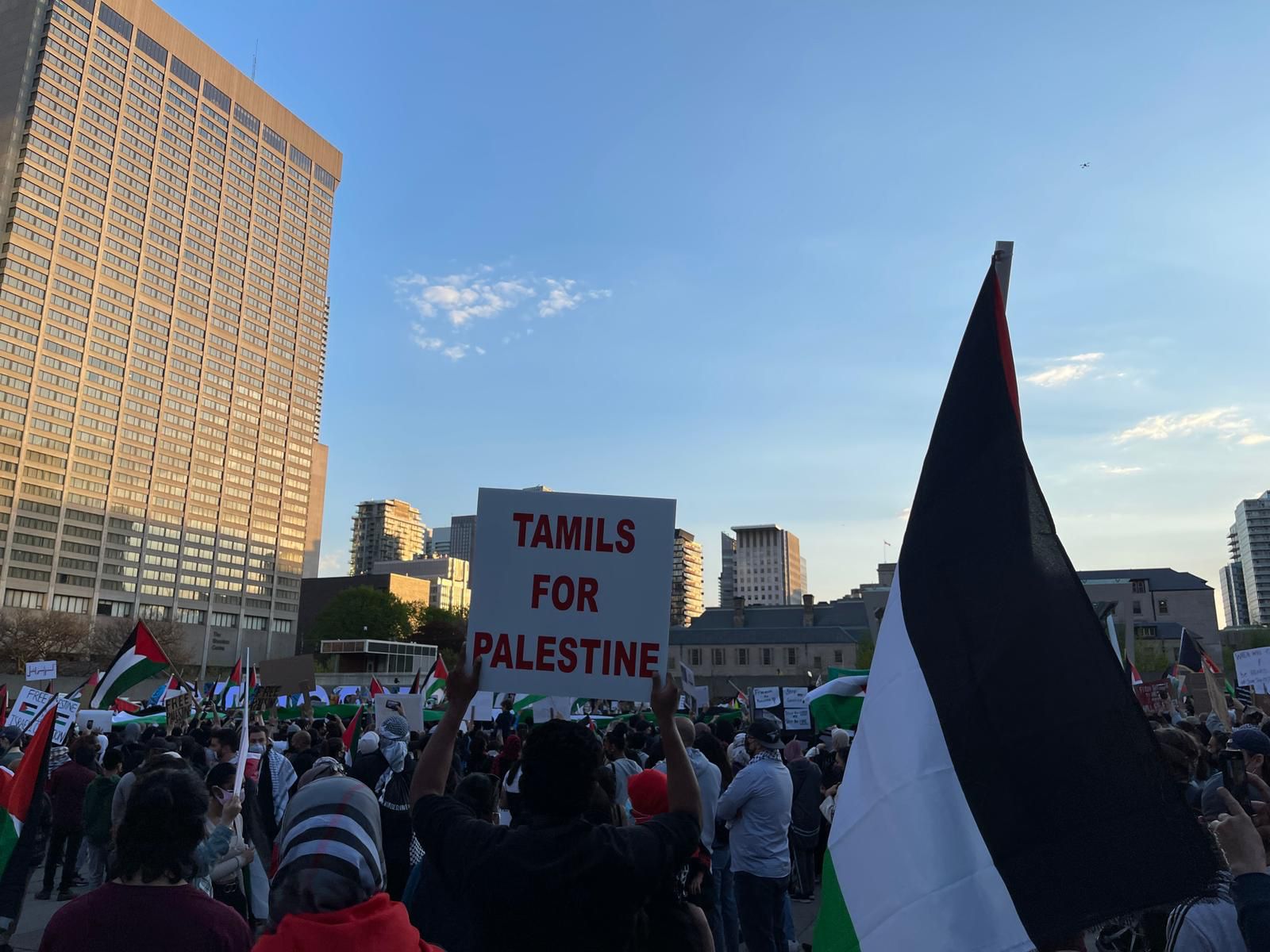
Watching Israel’s genocidal assault on Gaza as an Eelam Tamil has provoked the same impotent rage and grief that everyone else feels but also an eerie sense of familiarity. The parallels between Mullivaikal and Gaza are of course glaring – the modalities of killing, the denial of food and medicine, the bare-faced lying - but there is also another familiarity. This is in what takes place away from the killing zones; in the phrases, learned debates, polite conversations and enforced silences through which annihilatory violence unleashed by allegedly liberal states can be legitimised and sanctioned by a range of actors who otherwise think of themselves as morally good and progressive people.
The dominant western liberal frameworks that are used to explain conflicts in the Middle East, Sri Lanka and elsewhere have a Manichean character; there are the good and potentially liberal actors whose humanity can be recognised opposed by the bad and illiberal actors whose agency is explained entirely by fanaticism or the nihilistic pursuit of power and use of violence for their own sakes. In Sri Lanka, for much of the conflict, it was the state and allied actors who were seen as the morally good and potentially liberal agents, while the LTTE was tarred as a fanatical, sometimes ‘ethno-nationalist,’ sometimes ‘fascist’ terrorist organisation. Likewise, Israel, is still characterised by western allies as a beacon of democratic, queer friendly and woman friendly liberalism while its Palestinian and Lebanese armed opposition is tarred as fanatical, Islamist or Islamo-Fascist terrorism.
Israel’s backers, like Sri Lanka’s at the time, can countenance that their state can sometimes make mistakes or be excessive, but the state’s basic legitimacy is never questioned. In contrast, every act of resistance – whether political or armed, conventional or unconventional – is treated as an expression of political pathology and malfeasance. This was apparent in the immediate responses to October 7, and the annihilatory aftermath. The logic of the rhetoric was that while nothing in the past could justify the violence of October 7th, the violence of October 7th itself could justify any amount of annihilatory violence.

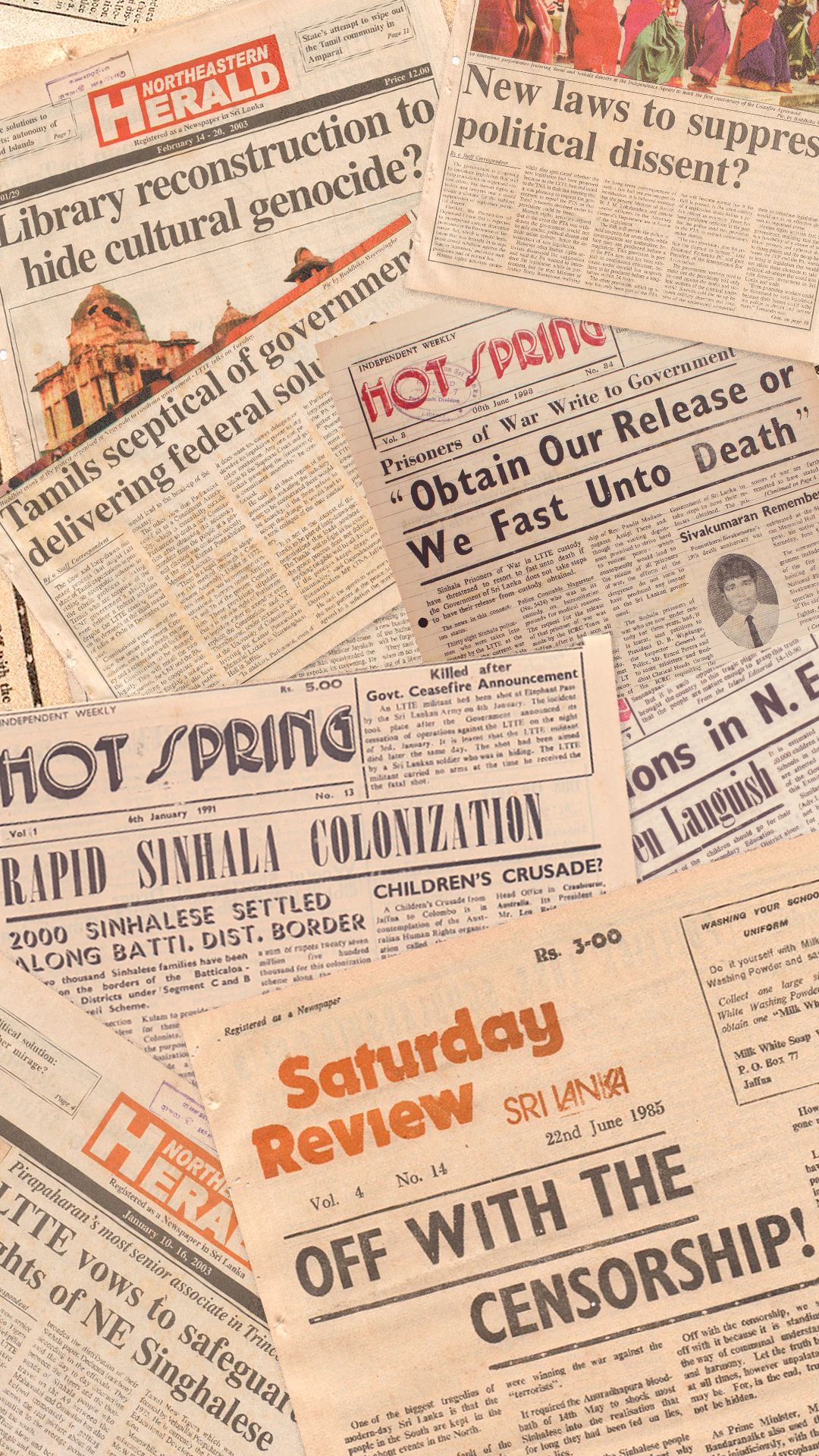
These arguments are part of Israeli and Sri Lankan violence; they are the enabling environment in which violence is sanctioned and materially supported. In Sri Lanka, terms such as terrorism, territorial integrity, child soldiers, suicide bombers and the simple denial of the history of state crimes worked to shut down debate and sanction violence. Likewise, in much of the mainstream media the violence of Israel’s assault on Gaza and that of Palestinian armed actors is presented and discussed without reference to history, to the Nakba, ongoing occupation, land dispossession, segregation and humanitarian siege.
Yet, what is also clear is that the narratives cannot hold forever and start to give way under the pressure of an unyielding reality and countermobilisation. This is evident in the democratic politics of western states. Think of high profile pro-Palestinian candidates like Zohran Mamdani or the suite of Democratic nominees who have just won primaries in New York. In the UK, the Labour’s party’s unequivocal support for Israel has been electorally toxic and arguably an important element of the demise of Keir Starmer’s premiership. Andy Burnham, the favourite to replace Starmer, has now apologised for his predecessor’s stance stating that his party’s response to Gaza has ‘often not been good enough.’
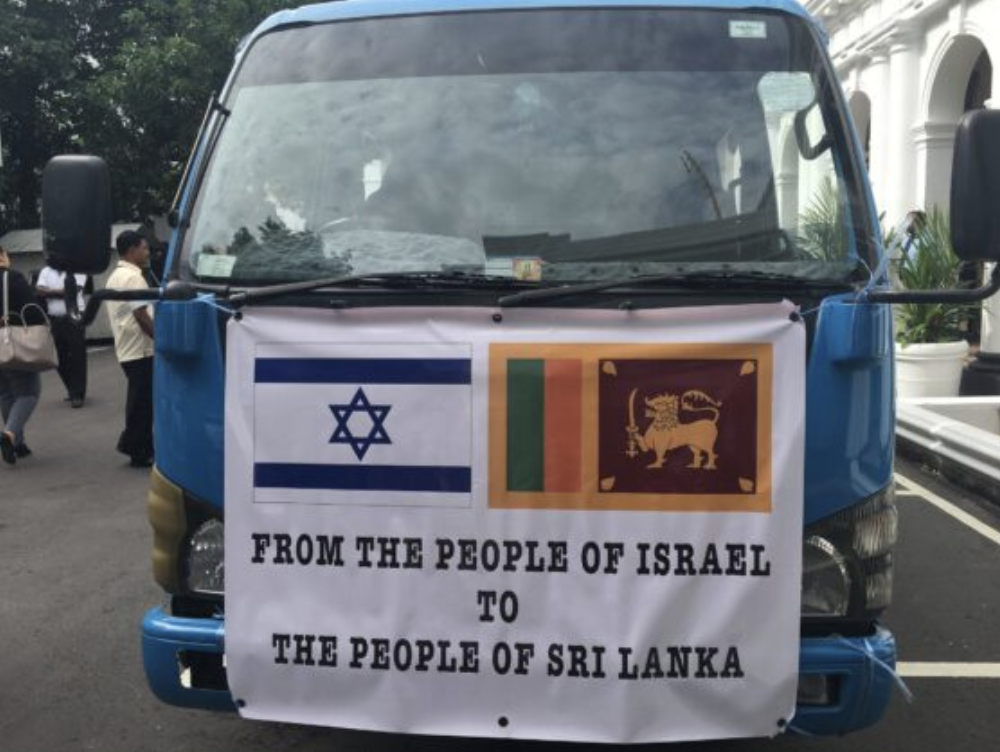
The narrative has also clearly shifted on Sri Lanka. There is now a slew of Tamil and non-Tamil political leaders, former judges and eminent global figures who have taken clear and unequivocal stands in support of Tamil rights, genocide recognition and the need for accountability. Behind them stands a robust body of evidentiary material in the form of UN reports, studied legal briefs, documentaries and witness testimonials that make ongoing denial and obfuscation a losing game.
I remember when the narratives on Sri Lanka started to shift; it was during the military’s whole-sale bloodletting in the Vanni. It happened first in small but noticeable ways. A moment that springs to mind took place in March or April 2009 when the full horrors of what was unfolding was beginning to be obvious to many non-Eelam Tamil onlookers. I was working towards my PhD at the time and some senior academics at my institution organised a little round-table discussion to air views on what was going on and how we might respond. They reached out to academics at other institutions who worked on Sri Lanka and invited me and my supervisor.
I was intensely preoccupied at the time with protests and other efforts to secure a ceasefire to notice much of the detail, but I see now that my sometimes gruff and aloof supervisor attended because he could see the calamity of what was happening. For him and the academics who organised the roundtable, Sri Lanka was no longer ‘a case’ but an atrocity that demanded some kind of response. Of course, as academics they reached for a roundtable rather than a protest. For me, Sri Lanka’s brutality in the Vanni was utterly predictable, for them as outsiders it was outrageous and unacceptable. It was only then that I began to believe that we might be able to shift the dial on international support for Sri Lanka.
That small event was important because it revealed both how narratives were beginning to shift but also how they had been perpetuated for so long. Amongst the attendees at the roundtable was a very senior academic from a different institution who had worked on Sri Lanka for several decades; they shall remain anonymous. This person thought it was completely normal and indeed appropriate to invite along an official from the Sri Lankan high commission – even though he was told there would be Eelam Tamil attendees, including me, with personal connections to the warzone. The High Commission official sat and wrote notes throughout the whole event and asked me for my views on the possibility of a post - LTTE Tamil politics centred on figures such as Arumugam Navalar.
The academics at my institutions were outraged and appalled at the behaviour of the academic who had thought fit to invite a Sri Lankan official. They apologized profusely, explained they had not known and were concerned for my safety. I appreciated their sentiments but was completely unsurprised; the academic in question was just doing what they knew. They were working with Sri Lankan officials and dismissing mounting evidence of crimes in the Vanni as either ‘unavoidable’ or ‘LTTE propaganda’.
A fellow Tamil academic, like me, a PhD student at the time, reported a similar incident. In the months after May 2009, another senior academic who had worked for decades in Sri Lanka stopped for a chat on the stairs. It was usual at the time that people who knew us would ask how we were doing, ask after the safety of our families and very often how they could engage and support us politically. This academic, however, did not do that. Instead, they spoke in generalities about how it was good the war was finally over and that we couldn’t really be sure how many people died. This was not unusual at the time and is still not unusual. While commonsense opinion on Sri Lanka had started to radically shift across the west, the circles most closely associated with the state and often vehemently anti-LTTE carried on as if nothing had happened.
This disjuncture continues even into the present. In most academic and policy spaces, I and my likeminded colleagues (Tamil and non-Tamil) can freely discuss and raise Sri Lanka’s history of mass-atrocities, the ongoing struggle for accountability and memory, land-dispossession and impoverishment. We can discuss the historical and political nature of Tamil nationalism, rather than its pathology, and its varied internal character. Yet, there are still spaces where old narratives and old habits persist. A recent expression of this is a newly published social sciences handbook on Sri Lanka; it makes no mention of genocidal violence and the ongoing occupation. It is like a handbook of Israel that fails to mention Gaza and settler violence in the West Bank.
These narratives are perpetuated in literary spaces as well. The recent novel, ‘Brotherless Night’ is replete with many of the same anti-LTTE tropes of fanaticism and the nihilistic pursuit of power. It has already been ably critiqued by T. U. Senan in the Tamil Guardian who points to the restricted caste/ class milieu from which these imaginings emerge. I want to pick up on something else here, the treatment of Thileepan’s hunger strike. In the novel this is largely disparaged as a stunt and a staged act. It is stripped of politics and agency. Yet, this was the 1980s and the figure of the political hunger striker loomed large; Bobby Sands’ hunger strike and his death are pivotal moments in the Irish Republican struggle, and it had global and diplomatic ramifications for the British government at the time. Thileepan is likewise a pivotal figure in the history of Eelam Tamil politics, and his act continues to reverberate. But these connections and reverberations are all impossible in the moral universe of the novel, where Tamil resistance is apprehended only as pathology.
The novelist must of course write the story that is true to them, and it is unreasonable to expect a single novel to tell every story. But what is interesting here is how typical this re-telling is of the milieu from which it emerged and therefore how limited it is. In it, Tamil politics is a morality tale; good versus evil and enlightened versus unenlightened. The enlightened are of course that small and closed caste/ class circle that Senan so clearly elucidates; they have agency, complexity and depth. In contrast, the Tamil nationalist actors are more like caricatures or cartoon villains; they have no development, no nuance, and certainly no global or historical context and connections. It is of course entirely predictable that liberal elites everywhere loved it and lapped it up.
But these connections and reverberations are all impossible in the moral universe of the novel, where Tamil resistance is apprehended only as pathology.
In Foucault’s famous formulation, politics is war by other means. The politics of recognising, naming and explaining the violence of the state and the violence that emerges to meet it is part and parcel of violence itself. In the months and years leading up to the final war in the Vanni, I and fellow activists struggled to make the case for Tamil demands; demilitarisation and normalisation of the Tamil homeland so that Tamils could engage with the peace process on fair terms. We warned, repeatedly, of the appalling violence Sri Lanka would unleash if it was supported in its return to war. We pointed to the massacres and humanitarian sieges of the past, the bombing of safe zones in Navaly and of schoolgirls in Sencholai. We were unsuccessful and the voices that demanded and justified Sri Lanka’s return to annihilatory war won out.
Yet, war is productive and transformative and reshapes the narrative fields on which it is conducted. Sri Lanka’s genocide in the Vanni and the widespread protests that erupted in response to it shifted the narratives and opened up what could be said and what was no longer unsayable. It was possible to acknowledge Tamil victims of state violence, the hideous asymmetries of violence and power between the state and the LTTE as well as the historical context of violence and resistance. The moral universe inhabited by the academic at the roundtable, the academic on the stairs, by the Sri Lanka handbook and by the novel began to shrink and another could be expanded. This shift is also now visible in western discussions of Gaza. Watching this unfold, as an Eelam Tamil, has unsettled a heady brew of emotions and memories. There is grief and there is rage. But there is also this sense of the ground shifting right beneath your feet and taking you to new places where you can speak and be heard.
Madura Rasaratnam is an Associate Professor of Comparative Politics at City, University of London. She is also Director of PEARL (People for Equality and Relief in Lanka). The views expressed in this essay are her own and do not reflect the official policy or position of City University or PEARL.