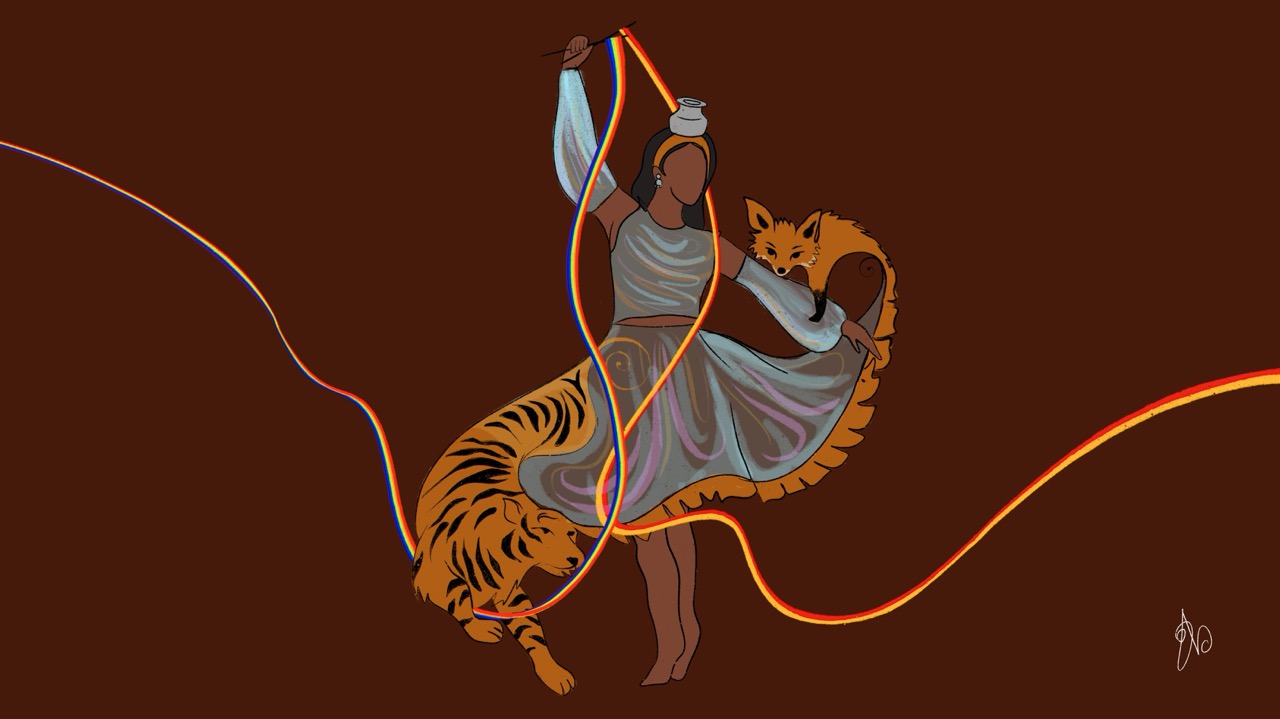
There’s a Tamil saying to describe a sunshower: narikkum kaakaakkum kalyanam. A wedding between a fox and crow. There are versions of this saying across Asia—in parts of India, they say a wedding between a fox and dog, and in South Korea, a wedding between a fox and tiger. In each fable, the fox falls in love with a different species, which we consider as impossible as rain on a clear day. The idiom perceives the fox as a trickster for desiring something impossible, or improper, therefore a sunshower is likened to a kind of deception. The fox is queer, and his desires are fugitive.
The closet, like a fox's den, is a shelter for fugitives. I began to feel the length of its walls in the suburban home of my babysitter, Mathi Aunty, the wife of a former fighter in the Tamil liberation struggle. I remember the anticipation of being dropped at her house. In those few hours we spent together, between Appa leaving and Amma returning, anything was possible. She loved to put on nadahams, depicting the Ramayana or Mahabharata. I was dressed in a blue and gold pattu, gold bracelets and chains, cherry-red lipstick, and mai across my eyelids.

Photo courtesy of author.
In the privacy of her home she let me be anybody—the hero prince or the maiden to be saved—without judgement. At least until it came time for Amma to pick me up, when the evidence of our illicit activity was wiped clean from my face.
°°°
I was first introduced to queer love through Sailor Moon, a Japanese show which followed a group of school girls, the Sailor Guardians, who used their luminous magic to protect the galaxy and build their utopian nation, Crystal Tokyo. I begged Amma for the latest dolls. My favourites were Sailor Neptune or Michiru Kaiou, a violinist, and her lover Sailor Uranus or Haruka Tenoh, a race car driver. Their same-sex relationship was considered “revolutionary” for their time. When the show reached North America, the dubbing was rewritten to depict them as cousins rather than lovers. I filled sketchbooks with drawings of Michiru and Haruka, kept hidden underneath my bed.
My Sailor Moon dolls were left behind when we went to the homeland in 2005. I remember the month we spent in the upcountry with Amma’s family, running with my cousins through rows of tea plants. I remember visiting relatives in the dead of night in Jaffna, after the curfews had begun, avoiding the attention of military patrols. I remember my parents speaking in hushed voices at a Colombo hotel—a minister had been killed and we had to leave in case they locked down the airport. I remember the woman at security, dressed in military fatigues, who smiled sheepishly as she tore apart my pencil case and sketchbooks in search of weapons, only to find the drawings of Michiru and Haruka.
°°°
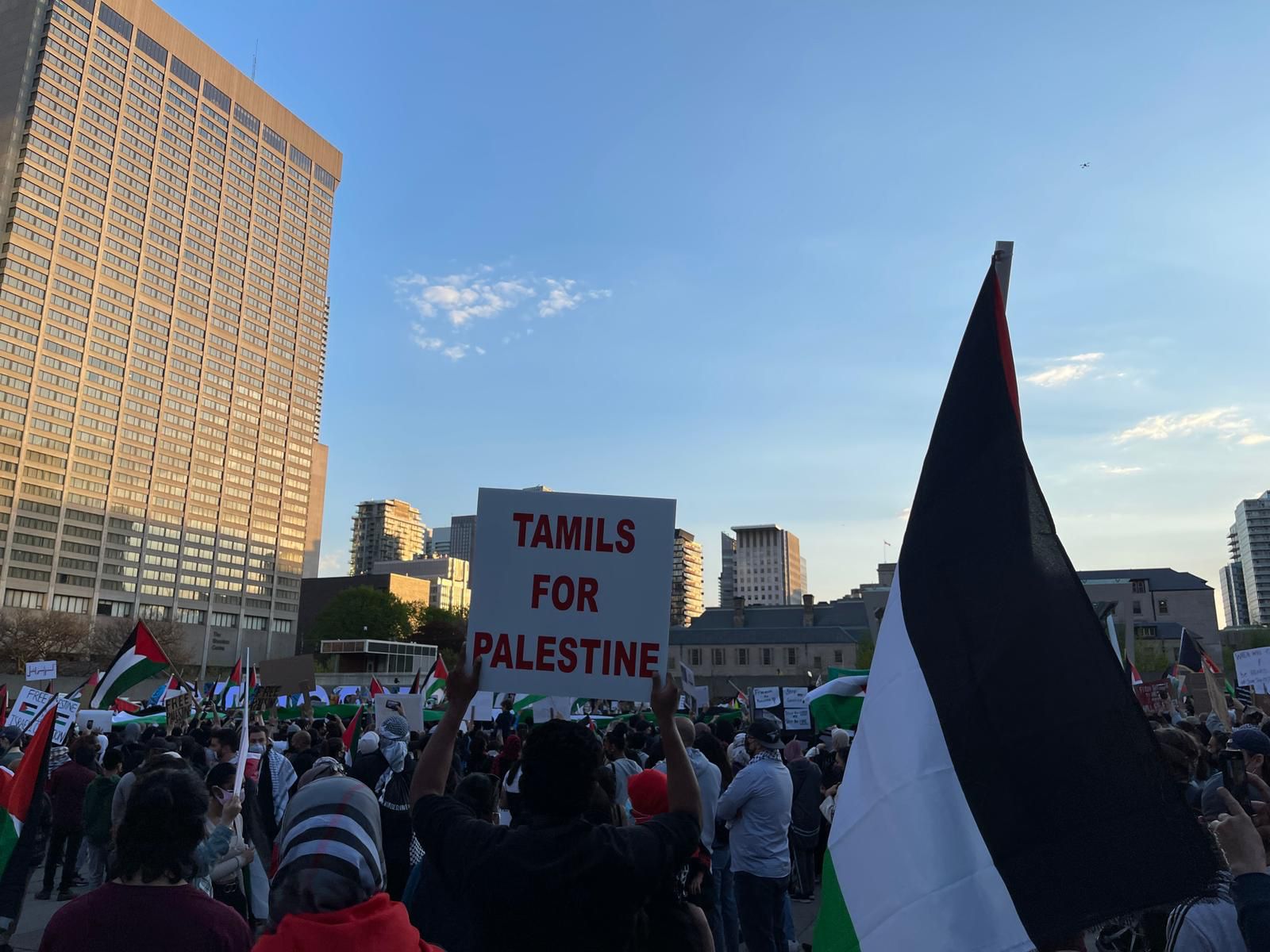
By 2009, the violence escalated drastically. I went to New York for the first time that year. Not to take the ferry to the Statue of Liberty, nor to get a big soft-pretzel in Times Square, but to protest the Tamil genocide. I was eleven. I remember thousands of Eelam Tamils converging on Manhattan, forming a river of bodies that flowed through the city’s streets. A myriad of faces were pressed against the windows of the tall office buildings which lined the street—office workers setting aside their day to watch our procession towards the United Nations. The collective roar of grandparents, parents, and children, felt like it would break the ground beneath my feet. I believed then that if I had just screamed loud enough, projected my voice to the 38th floor, Ban Ki-Moon would hear our demands, come outside to the front steps of the building and present us a treaty ending the violence and recognising the nation. I didn’t know then that these were illicit desires.
It was an eight hour drive from New York back to Toronto. I had loaded up ten or eleven songs on my orange thumb-drive MP3 player, my favourite of which was M.I.A’s “Sunshowers.” The lines “you wanna go? you wanna win a war? / like P.L.O. I don't surrendo’,” rang against the bongo drums and synth tunes as I stared out the window and bit into my big soft-pretzel, deflated.
In New York, the nation felt imminent. But with each day that passed, as the death toll grew and more footage of the carnage arrived, it began to slip from between my small fingers. Amma would drive downtown each night for a continuous protest in front of the U.S Embassy. I was only allowed to tag along if it wasn’t a school night. She would sometimes stay into the morning, oscillating between impassioned chants and standing quietly next to me. Amma, who grew up in the upcountry far from Eelam, held onto hope until the very end.
°°°
After May 2009, I started to realise I was different from my peers. Compared to the other boys, my walk was funny, my wrists were loose, and my voice was an octave higher. I listened only to music written by women—M.I.A., Florence + the Machine, and Rihanna—while they preferred 50 Cent and Lil’ Wayne. I was often the butt-end of a joke and the first one to get pushed around on the playground.
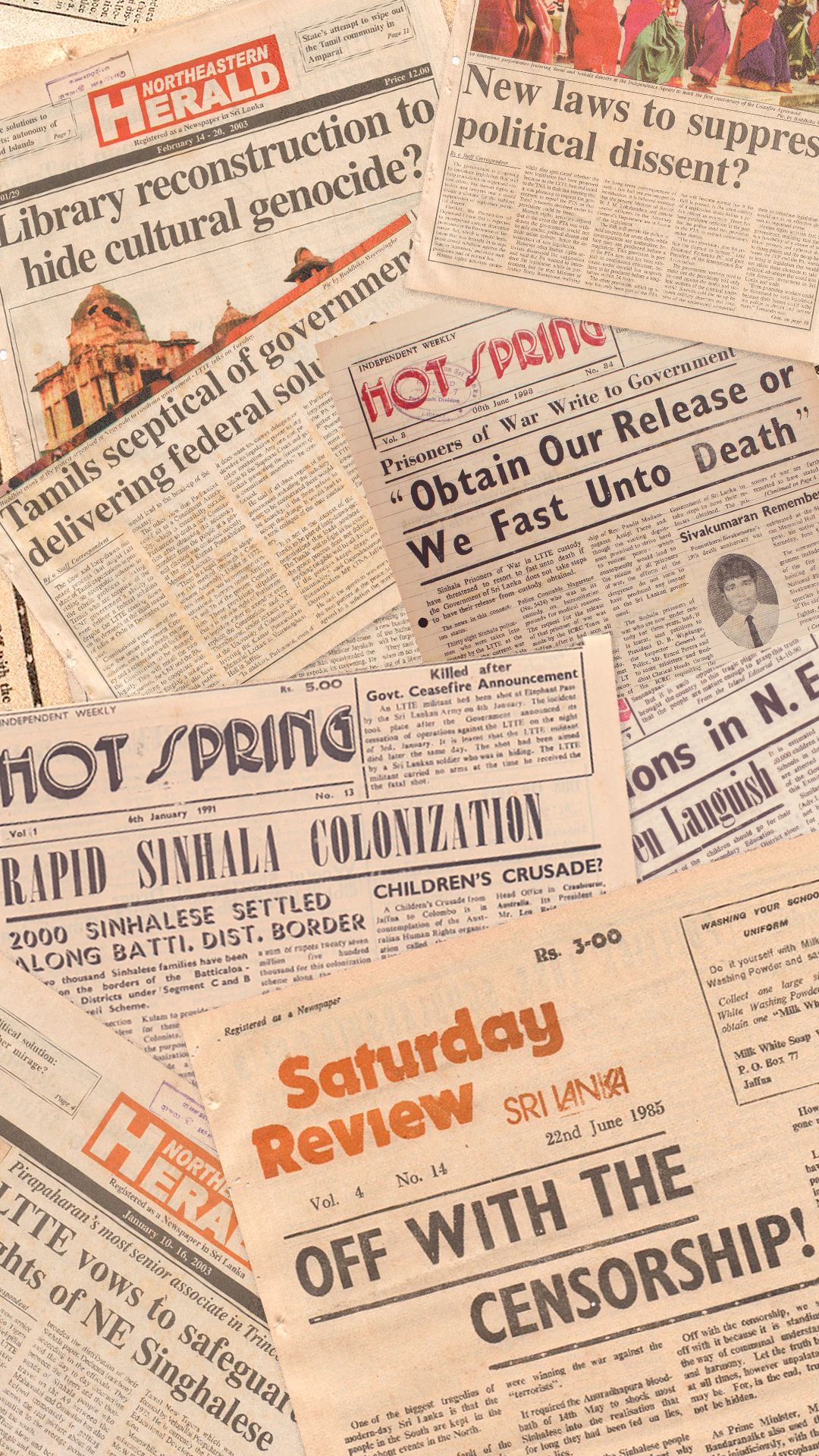
I didn’t need fists to fight. I would often start arguments with my classmates, angry at their indifference towards the genocide. I remember one day I got into a fight with another Tamil student, who told me that the movement was just a bunch of terrorists and I shouldn’t speak if I didn’t know the truth. A teacher quickly broke it up. She said “the classroom isn’t the place for politics.” I returned to my seat, eyes lowered towards the doodles in my notebook.
Just before school ended for summer holidays, I got a series of messages from the other boys in my grade. They said I needed to stop acting “weird,” and they had come to an agreement not to talk with me for the summer. I didn’t know what “weird” meant. Was it the way I spoke, or what I spoke about? I spent those two months confined to my bedroom, the window ajar to let in cool air and the sound of the other kids zooming by on their bicycles, wondering what I had done wrong. That summer instilled an important lesson: if I wanted to get by, I had to learn to blend in.
°°°
Mathi Aunty’s husband, along with a group of uncles who met in the movement, would occasionally gather at our house to drink and play cards. Their game was Rummy, paired with a bottle of Famous Grouse. I despised it at first, the smell of whiskey and sweat soaking their shirts, bleeding onto me with their big burly hugs. At first, I felt a distance between myself and these men, without being conscious then of what it might be. A fear of them finding the Sailor Moon dolls that awaited me upstairs, tucked away in my closet. But as I grew older, wore baggier jeans and muted t-shirts, evened the tone of my voice—as I learned to camouflage—they taught me to play.
Rummy, like poker, requires a level of cunning. You must conceal the cards you desire and mislead your opponents until the final reveal of your hand. As the cards were dealt, glasses were refilled, and plates of deviled mutton devoured, they told stories of their time in the movement. They debated and critiqued each other. Raised voices were interspersed with bouts of laughter. They spoke about their visions for the Tamil nation, the ones they fought for and the ones they were no longer sure about. As a young boy I was focused only on my hand, but their drunk musings soaked into my consciousness. I managed to win a few games too. These men, who spent their twenties evading capture, said I was a real trickster. It was a compliment I didn’t fully appreciate.
They spoke about their visions for the Tamil nation, the ones they fought for and the ones they were no longer sure about.
When I later came across the writing of queer Palestinian scholar Tareq Baconi while searching for the language to articulate my own queerness, I strangely returned to these uncles. He says, “I identify as a queer man today as part of a political project. It’s not just a sexual identity. It expands beyond that […]” To the uncles, the homeland was not only a label or a site of pain. It was a dream, an orientation, and a tension. As Baconi says, a political project.
After the bottle was finished they’d say long goodbyes, slurring their words as they joked with each other from the dinner table to the door, before donning their own masks and returning home.
°°°
The first man to see the real me, the first man I ever loved, was a Mauritian Tamil writer. We met in Johannesburg, while he was a graduate student and I was there for an internship. It was on our second date, on my birthday, that I started to fall for him. After the movie, we went to the bar next to the theatre and sat on the patio. It was largely empty, except for a well-dressed group of friends who had pushed the tables aside and gave the DJ their list of Amapiano tracks to dance to.
We sat close enough so our knees brushed gently, intermittently calling the waiter over to order another drink, discussing what a Tamil nation would feel like for both of us. In between puffs of his cigarette, he spoke about Kumari Kandam, a mythological place that may have once connected East Africa and South India together. Apart from references in Sangam literature to a landmass swallowed by the Indian Ocean, there is little evidence of its existence, but perhaps that didn’t matter. For him, what was important was the idea of a gathering place. I told him how the Tamil nation I envisioned was similar, it would be a place where he and I, a Mauritian Tamil and an Eelam Tamil, could meet. Perhaps, a place where we could fall in love.
I was grateful to the people dancing carelessly next to us, the bass of the speaker drowning out our conversation so that an onlooker might assume we were old friends reminiscing over a drink, never catching wind of our desires. We stayed at the bar drinking until our bottle emptied—gin rather than whiskey—debating over, laughing about, and imagining the nation. When Amma later called to ask what I had been up to for my birthday, I told her I’d just gone for dinner with a friend.
Our time together continued this way. A clandestine love. We lay in the dark, our legs intertwined on his twin-sized bed, the window cracked slightly to let out cigarette smoke and let in the glow of the street light, the coarseness of our chest hairs tickling each other's skin. Hours passed, our eyes towards the ceiling rather than each other, exchanging the occasional glance as we talked. For us to meet—two Tamils displaced by different forces across continents and oceans—felt impossible. Yet there we were, dreaming together. The yellowing popcorn ceiling was a canvas on which we traced lost histories and imagined new worlds.
The words of queer Cuban writer, José Muñoz, often echoed in my mind: “The here and now is a prison house. We must strive, in the face of the here and now’s totalising rendering of reality, to think and feel a then and there. [...] we must dream and enact new and better pleasures, other ways of being in the world, and ultimately new worlds.” Perhaps our meeting was fated. He offered the chance—or rather, permission—to dream. A way out of the here and now.
And my dreams—whether of the nation or of my queer life—were not particularly extraordinary. As I sifted through the digital archive Queering the Map, I realised most queer dreams are rather ordinary. It was filled with ordinary encounters—entries of first kisses, missed connections, and fated one night stands written by anonymous participants, which together, formed a queer counter-mapping in the geography of everyday life. There are a handful from across the homeland. Someone from Mannar writes: “I might never come out to my grandparents or relatives, but this is my silent prayer that one day you'll get to see and talk to the real me. [...] I hope, more than ever, that one day I can stand next to you with my head held high, ready for anything you throw at me. But for now, I'll prepare myself.” For this person, their only dream is to live with dignity. But in the present it was contraband, smuggled to the internet in their desire to be witnessed, even anonymously. I wondered then what other dreams didn’t make it here? What dreams filled the dimly lit bedrooms of queer Eelam Tamils in Jaffna, Kilinochchi, and Batticaloa. In New York, Berlin, Kuala Lumpur, Chennai, and Sydney. What did they look like and where did they take place?
In mine, we’re seated along the beaches of Appa’s hometown, Point Pedro, having a beer. The military camp is no longer there. The clouds are few and far between, allowing the stars to cast a navy hue over everything. Our eyes moving past the lighthouse and the fishing boats towards the ocean, searching its ripples for what may be hiding underneath.
What dreams filled the dimly lit bedrooms of queer Eelam Tamils in Jaffna, Kilinochchi, and Batticaloa. In New York, Berlin, Kuala Lumpur, Chennai, and Sydney. What did they look like and where did they take place?
°°°
Perhaps the way to a new world begins in the past. I searched online and through archival materials for traces of queer history in the struggle for national liberation, but came up short. There were whispers and fragments, a handful of stories. Not enough to paint a picture. As with most queer history, it was locked away and hidden. Knowing the history was there but having no means of uncovering it was frustrating. I felt adrift without history, I had nowhere to anchor myself. Perhaps, while I couldn’t uncover history, I could reclaim the past in service of the future. The objective of the 1976 Vaddukodai Resolution was not only to resist Sinhala Buddhist chauvinism, but to build a free and equal Tamil nation. While referring to caste, it writes that in the Tamil nation “the observance of the pernicious practice of untouchability or inequality of any type based on birth shall be totally eradicated [...].” Could that include us? Even if the original intention was different, a queer re-reading of the resolution opened up the possibility of a nation where we can love—and be—whoever.
And perhaps, a new world was closer than I thought. The images of this year's Jaffna Pride march were breathtaking—queer and trans people out on the street against the scorching sun, their rainbow flags on full display, dancing, playing drums, and holding placards with calls for equal rights written in Tamil and English. Colombo is often seen as the gay capital of the island. More accepting, more “progressive.” But now in its fifth year, Jaffna Pride works to challenge that narrative, carving more space for queer Tamils in the homeland. The march began at the Jaffna Public Library, which was destroyed by Sinhala police in 1981. The numbers have grown year after year and now, Pride events have sprung up across Tamil areas in Batticaloa and Malayagam, where I used to spend summers as a child.
There were many smiling faces. There were many wearing masks or covering their smiles with rainbow flags. Even under surveillance I saw these as glimpses of the future, arriving in the present as an act of defiance. I wonder if those who came before us would ever have imagined such a possibility? I looked backwards towards the people I had to thank for my life, and forwards, towards the expanse we have yet to cross.

The 2026 Jaffna Pride, organised by the Jaffna Transgender Network, marching under this year's theme: "We Exist for Each Other."
Waiting for rain to fall on a clear day may seem pointless because it transgresses our rationality. From the outside looking in, love between a fox and crow is an impossibility. But perhaps, when we aren’t watching, the fox would approach the crow, bring its snout to the crow’s beak, and kiss. And each time they do, it rains. Perhaps a sunshower is proof that their love is possible.
When I told Amma I was gay, I thought that would be the last day we spoke. Escape from the closet was an abyss, from which I couldn’t see a return or an after. As the words sat in my mouth, ready to flee through the thin separation of my lips, the unknownness of the future took the air out of my lungs. The confession arrived less as a declaration and more as a whisper. Amma, who lost everything in the riots of 1983, didn’t dare lose her son. As we sat together by Lake Ontario, our eyes fixed on the horizon instead of each other, she said “I’ll always love you, mahan.”