When the war ended in 2009, for many Tamils and outside observers, there appeared to be scant hopes for a continuation of the Tamil struggle, and with it, Eelam Tamil nationhood. After all, the genocidal violence inflicted by the state was designed to achieve precisely that – the subjugation of Tamils within the Sinhala-Buddhist hierarchy and the destruction of the idea of a distinct Eelam Tamil nation. However, the initial years of extreme repression acted as an incubator for a people’s resistance, which gradually reclaimed some of the space that was lost with the cataclysmic conclusion to the armed conflict.
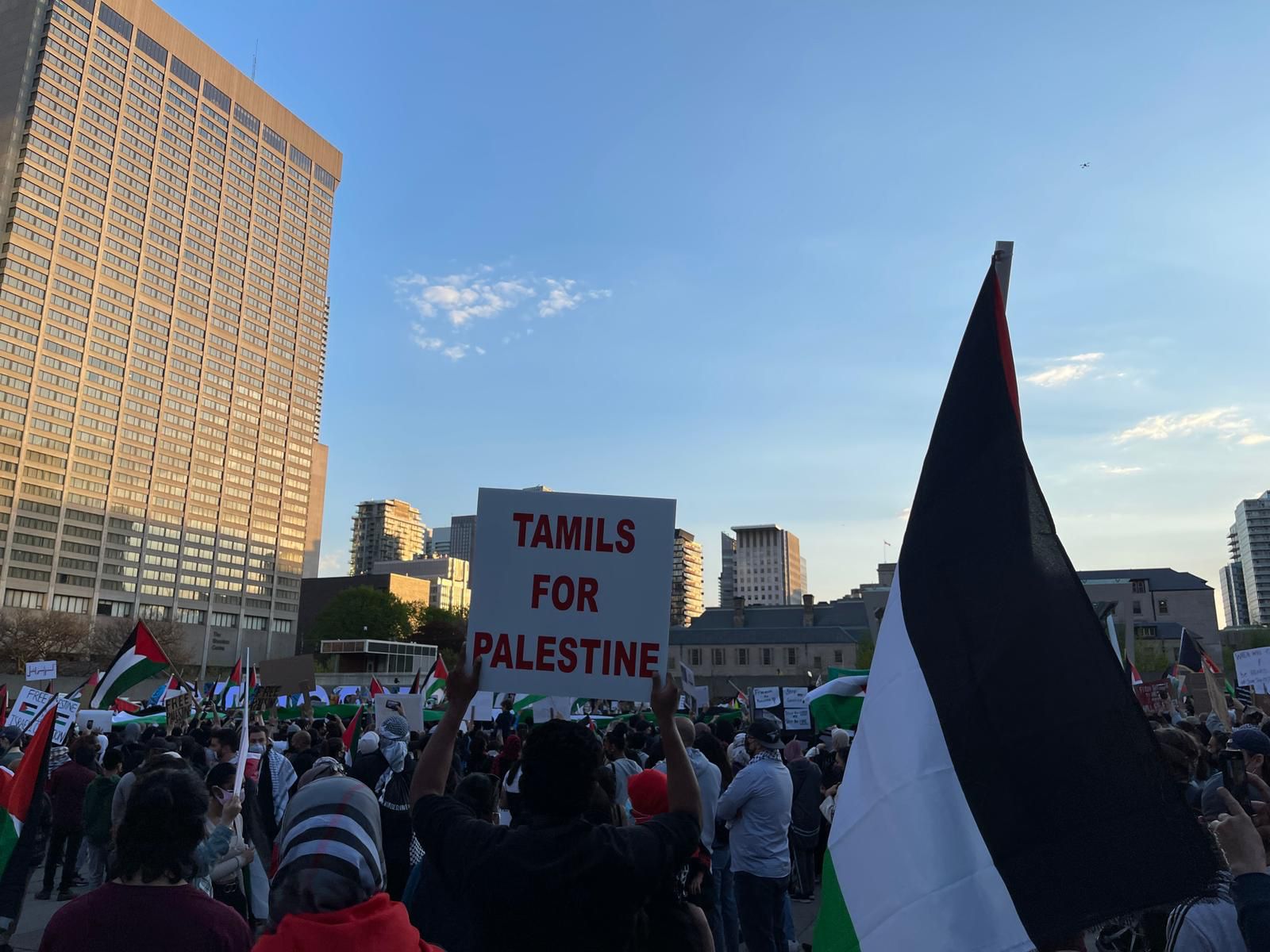
Today, a Tamil nationalist rationale is ubiquitous, part of the public domain and popular culture, in both the homeland and in the diaspora. Since 2009, the locus of Eelam Tamil nationalist mobilisation has been with the people, dispersed throughout the North-East and in the diasporas around the world. In the homeland, people regularly participate in rallies, protests and commemoration events. For example, Maaveerar Naal on November 27th and Tamil Genocide Remembrance Day on May 18 have become key focal points of the Tamil calendar. The P2P rally in 2021, when Tamils marched from Pottuvil in the very south of the homeland to Polikandy in the very north, saw widespread support across the region. Outside the homeland, the construction of a genocide monument in Canada, depicting the outline of Tamil Eelam, was hailed by Tamils around the world.
But even beyond such politically charged manifestations, the transnational production of Eelam Tamil-centric culture is indicative of the normalisation of a national consciousness and has concretised a sense of nationhood that ties together a disparate population. From comedy routines to movies, content creators and influencers, Eelam Tamils in the homeland are producing nationalist content, in enthusiastic collaboration with Tamils in the diaspora – and vice versa.
This vibrant, decentralised flowering of nationalist sentiment marks a break with the traditionally hierarchical dynamics of Tamil politics. In colonial times, Tamil politics revolved around elites in Colombo. With independence, this centre moved to Jaffna, with first the ITAK and then with the LTTE based in the town and directing the liberation struggle. During the war, the centre shifted to the Vanni, and the LTTE’s de-facto state structures provided the institutional scaffolding for Tamil nationalism, materialising what was hitherto only aspirational. The loss of territorial control following the demise of the LTTE, and the resultant military occupation of the entire Tamil homeland, meant this centre again shifted – this time off the island, to diaspora centres such as London, Paris and Toronto. This was due to the severe restrictions placed on Tamil political expression by the Sri Lankan state in the aftermath of the war.
Yet, in subsequent years, more and more Tamils brave the risks of intimidation and detention to commemorate the day, building makeshift memorials at the destroyed LTTE cemeteries and decorating streets and buildings with red and yellow pennants.
In the years following the end of the war, Tamil resistance to the Sri Lankan state’s repression intensified on the island. This was not organised resistance in the traditional sense, with top-down infrastructure directing these activities. Rather, grassroots movements emerged in several localities and coalesced, pushing back against the securitisation by the state. The first public observations of Maaveerar Naal after the end of the war were organised by students at the University of Jaffna. They were attacked by the security forces, and several students were arrested. Newspapers that covered the events were targeted too. Yet, in subsequent years, more and more Tamils brave the risks of intimidation and detention to commemorate the day, building makeshift memorials at the destroyed LTTE cemeteries and decorating streets and buildings with red and yellow pennants.
At the same time, Tamil families of the disappeared organised themselves into a vibrant protest movement, largely led by female relatives of those forcibly disappeared by the Sri Lankan state throughout the war. While nationalism and its symbols and rituals are inherent to Maaveerar Naal, these protesters made a conscious choice to follow Tamil nationalist frameworks in the articulation of their demands. The symbols introduced and popularised by the Tamil nationalist movement, such as the red and yellow colours, are omnipresent at protests by the families of the disappeared, and those organised around land and other issues.
Today, Maaveerar Naal is observed widely by Eelam Tamils in all corners of the homeland and the diaspora. Whether the participants are at the LTTE cemetery in Kanchikudicharu, Amparai, or at a school hall in Vanta, Finland, the practices and ceremonies are virtually indistinguishable. Observing the same rituals, playing the same songs and conveying the same valorisation of sacrifice means that Eelam Tamils are tied in a globe-spanning performance of national being. The homeland and the diaspora remain connected and in constant conversation with each other, with traditions and customs, but also popular culture, travelling both ways. For Tamils on the island and abroad, the common social understanding that is enacted through these practices emphasises that they belong to the same nation.
This normalisation of Tamil nationalism across location and identity categories picked up on some of the formative dynamics of the movement from the 1950s, which were later abandoned to the exigencies of politics. In those early days, the leaders of the ITAK were intentional about “non-domination” of some Tamils over other Tamils. Identifiers such as caste, religion, and your place of origin were all important, in some respects more so than the Tamil identity. SJV Chelvanayakam and his ITAK had to make the case for Tamil nationhood, overcoming these differences. Following this strategy, the TULF and the LTTE in particular sutured extant differences and cleavages within the Tamil people in service of the greater struggle for Tamil liberation.
For a while, they pretended the nationalist mobilisation wasn’t happening, and when it became more noticeable, they dismissed it as the preserve of a few fringe actors, arguing that Tamils were more concerned with livelihood issues than with the resistance to the ethnocratic state.
With the end of the LTTE in 2009, the TNA failed to pick up the leadership mantle and instead headed in the opposite direction. The alliance led by ITAK tried to steer Tamil politics away from nationalism, attempting to present Tamil demands to Colombo without threatening Sinhala-Buddhist majoritarianism. For a while, they pretended the nationalist mobilisation wasn’t happening, and when it became more noticeable, they dismissed it as the preserve of a few fringe actors, arguing that Tamils were more concerned with livelihood issues than with the resistance to the ethnocratic state.
Self-consciously oriented towards Colombo, the TNA’s leadership studiously avoided participation in Tamil nationalist events, instead delegating that task to some of their MPs. A dual strategy emerged, where the leadership would ingratiate themselves with Colombo’s elites, while other MPs would continue to claim to be the true heirs of the LTTE and their fight for liberation. As the depth of Tamil nationalist feeling among the people became more apparent, the entire TNA was forced to embrace such politics, albeit not before they suffered electorally for their Janus-faced approach.
The dominance of Tamil nationalist sentiment can also be inferred from the actions of Sinhala nationalist parties. Tamil candidates of the Sinhala parties also campaign in ways that take Tamil nationalism for granted. For example, Tamil NPP MP Rajeewan Jayachandramurthy paid his respects to Lt Col Thileepan. During their election campaign, another NPP campaigner compared Anura Kumara Dissanayake to Velupillai Prabhakaran. In 2018, even Rajapaksa’s SLFP played LTTE songs during their rally in Jaffna. This does not mean that these parties endorse Tamil nationalist sentiment; on the contrary. However, their actions betray how self-evident the Tamil nationalist psyche has become even for those opposed to it. Their calculation is that the votes they gain by deploying nationalist sentiment will outnumber the votes they would potentially lose by those opposed to the LTTE.
Therefore, today Tamil nationalism has again become ubiquitous in the everyday. Tamil nationalist principles have become normalised in a way that we have not previously seen outside LTTE-controlled territory. The normalisation of Tamil nationalism in everyday popular culture is indicative of how the state’s efforts to eradicate Tamil nationalist sentiment have failed.
This normalisation of Tamil nationalism beyond (and despite) the political parties signals a shift. For the first time since Sri Lanka’s independence, the Eelam Tamil people are no longer led by a top-down institution. Women and the youth have mobilised themselves, despite repressive conditions and outside the traditional political structures, which remain the nearly-exclusive domain of elite older men. Meanwhile, the parties provide virtually no representation of these sections of society. As a result, for much of the general public, politicians are mostly perceived as a formality – maintaining some semblance of Tamil nationalist representation in Colombo.
Consequently, the state of Tamil nationalism should be gauged on the activities of the Tamil people more broadly, rather than judged on the dismal state of the political parties. In an ideal world, the old guard would make way in order for a new dynamic polity, one that stays true to the core principles of Tamil nationalism, to emerge. In the 1970s, ITAK followed pressure from the people to take the position articulated in the Vaddukkoddai Resolution. Similarly, today’s political parties must follow where the Tamil people are leading. The extant parties’ conduct over the last 17 years makes one doubtful that they are willing or able to do this. Instead, different, perhaps unorthodox, political structures must be built, ones that do not concentrate their efforts on maintaining a presence in the parliament in Colombo. A serious alternative movement that centres the Tamil people’s nationhood in egalitarian and pluralistic principles is within our reach. The compass must continue to be oriented towards the everyday Tamil people, on and off the island.