The 50th anniversary of the Vaddukoddai Resolution falls on 14 May. Despite the intervening half-century, the conditions in Sri Lanka that gave birth to the Resolution remain almost intact, forcing Tamils to resist Sinhala hegemony and stand up for dignity, justice and equality.
The Resolution, drafted in 1976, is dual in nature: the first part sets out the conditions in which Tamil people lived; the second calls for secession. The conditions describe Sinhalese and Tamils as people possessing distinct identities and historically governed separately by rulers until brought together by the British in 1833 for “administrative convenience;” the transfer of power at national independence in 1948 giving Sinhalese dominance while rendering “Tamils a subject people;” Tamils becoming further disempowered when the Sinhala-majoritarian parliament after independence disenfranchised a large group of Malayaga Tamils and legislated Sinhala as the sole official language; and Buddhism being given the “foremost place” in the 1972 constitution to the detriment of other religions. The Resolution also details the insecurity faced by Tamils due to periodic riots and army and police brutality.
The document then elaborates on steps taken by Tamil leadership to negotiate with successive governments to restore equality between the Sinhalese and Tamils and how they failed. It blames the failure on the character of the state and the obduracy of Sinhala leaders. The Resolution cites how “balanced representation in a Unitary Constitution” proposed by the All Ceylon Tamil Congress was not accepted, and legislative reform put forward by the Ilankai Thamil Arasu Katchi “for an autonomous Tamil State within the framework of a Federal Republic of Ceylon” was summarily rejected by Sinhala leaders of the constituent assembly that was drafting the 1972 constitution. The Resolution records notice given by the Tamil United Liberation Front that unless its six demands submitted on 25 June 1972 were honoured, it would launch “nonviolent direct action against the Government.”
Today, 50 years since the Resolution came into being, and after over 150,000 died in the war, Sri Lanka resists opportunities to evolve into a more pluralistic, fair, and democratic state. This has resulted in an unevenness in the experience of citizenship between Tamils and Sinhalese and led to Tamils being condemned to a life of perpetual fear, especially in the country’s militarised Northeast, where a substantial portion of them live.
In the past five decades, several promises to reform the constitution were made, only to be abandoned.
The unitary constitutional format that Tamil leaders perceived as a hindrance to democratic politics in 1976 has also persisted, facilitating Sinhala supremacism and blocking power sharing with Tamils and Muslims. Nor has time changed the lack of political will among government leaders to forge a constitution that makes the state more inclusive and democratic. In the past five decades, several promises to reform the constitution were made, only to be abandoned.
The pledges form a pattern. Governments propped up by strong Sinhala Buddhist constituencies, by their very nature, refuse to share power with other groups. Regimes proclaiming to be more liberal and inclusive give the appearance of trying, only to give up quickly, feigning fear that they would be outflanked by forces backed by the Sinhala-Buddhist lobby. So, in effect, nothing happens.
Another matter to which the Resolution refers is the Tamils’ insecurity, which in the 1970s was mostly deadly anti-Tamil pogroms and acts of brutality by the army and police, but exploded in the ensuing half-century into systematic violence and mass atrocities. The civil war and its immediate aftermath witnessed atrocities designated by the U.N. as war crimes and crimes against humanity. However, a lack of political will has shielded military and political leaders from being prosecuted for atrocity crimes. Governments after the civil war have reluctantly made vague statements about setting up local judicial mechanisms to inquire into war crimes, which Tamils, survivors, and human rights experts dismiss out of hand because they will not get justice for the victims. Sri Lanka refuses to consider the alternative – trying war criminals in courts supervised by international judges, citing that it is an intrusion into Sri Lanka’s sovereignty.
The confidence of guilty military and political leaderships that they will not be made accountable has bred impunity to continue ruling Tamils through fear: On 19 November 2023, for instance, Nagarasa Alex (25) of Sitthankerny, Jaffna, was pronounced dead when admitted to the Jaffna Teaching Hospital for treatment. Earlier, he was arrested on charges of robbery by the police. Before being taken to the hospital, where he would die, Alex recorded himself describing how he was tortured by the police.
Over time, free public discussion has been choked further by the Prevention of Terrorism Act (PTA) and the strengthening of Emergency Regulations by including virtually any matter as inciting terrorism.
What is worse, candid conversations about constitutional reform, or mentioning atrocity crimes at all, in the media, are now nearly impossible. There were restrictions on the freedom of expression even when the Vaddukoddai Resolution was proclaimed. Emergency Regulations, then in force, prohibited free debate on certain matters if government censors deemed that they were “prejudicial to national security.” Over time, free public discussion has been choked further by the Prevention of Terrorism Act (PTA) and the strengthening of Emergency Regulations by including virtually any matter as inciting terrorism. The PTA that is said to have a “disproportionate impact on … particularly Tamils and Muslims,” has terrorised Tamil journalists, enhanced self-censorship, and polarised the media ecosystem with the Sinhala and English media reporting few Tamil issues, and vice versa.
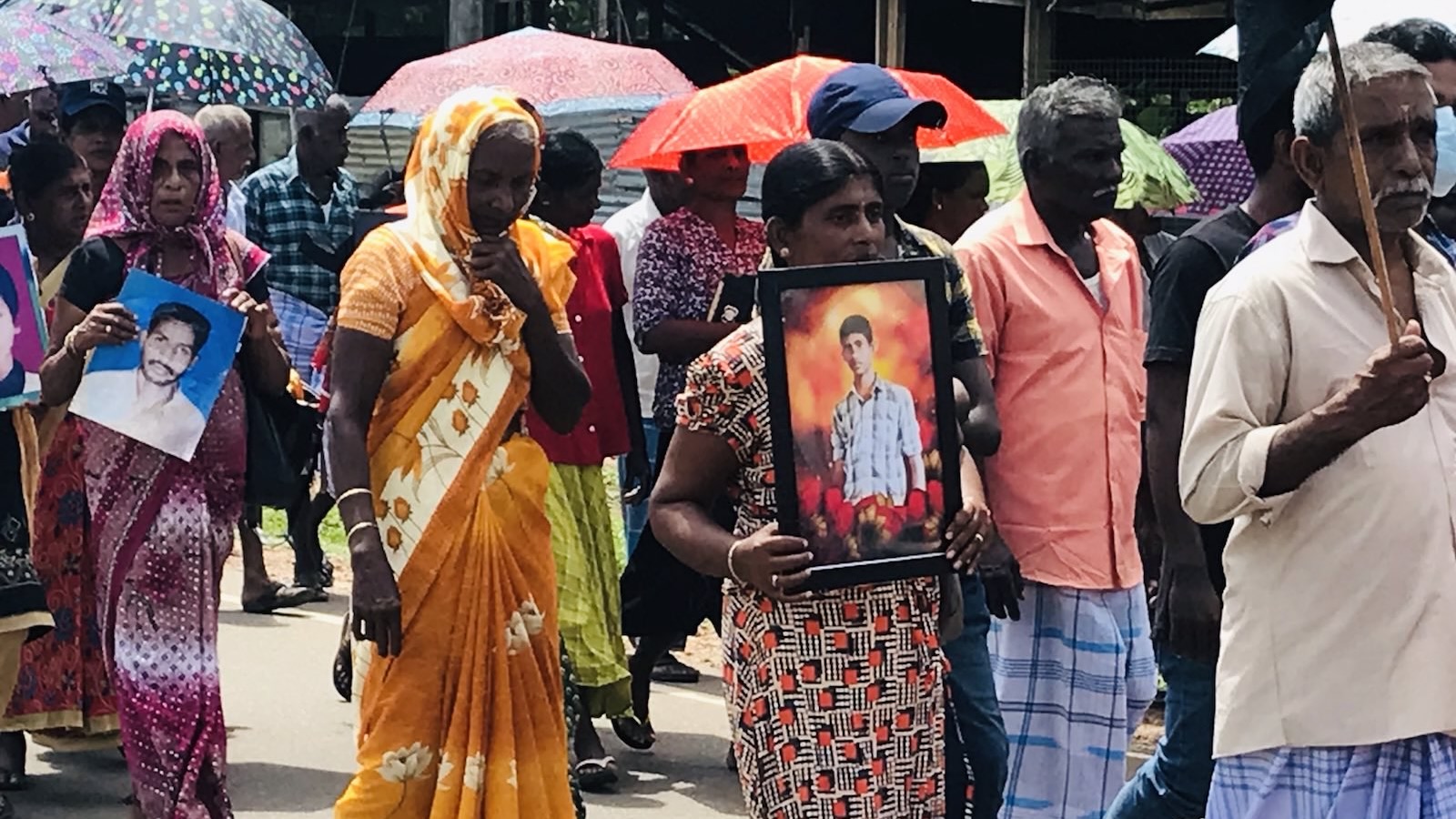
On the other hand, postwar repression has not succeeded in ending the Tamils’ nonviolent resistance. The mothers of the disappeared were a loosely organised group when the armed conflict ended. Observing the futility of seeking justice for atrocity crimes within Sri Lanka, they tried to find sympathetic outlets overseas. November 2013 presented an opportunity with the visit of British Prime Minister David Cameron to attend the Commonwealth Heads of Government Meeting in Sri Lanka. They planned to meet Cameron to discuss the disappearance of their loved ones and ask for his support. However, their efforts to see him either in Colombo or Jaffna failed due to police violence. Despite the disappointment, by defying the regime’s attempt to silence them, the mothers of the disappeared demonstrated agency and potential to undo the shackles of state repression.
What was an ad-hoc body in 2013 had, through its acts of collective resistance, become by February 2017 a formal organisation – the Association of Relatives of the Enforced Disappeared (ARED). ARED has, for the past nine years, braved violence, intimidation and scorn to advocate for truth and justice about the disappearances that occurred during and after the civil war. Its tireless campaigning has not only been instrumental in organising innumerable protests in Northeast Sri Lanka and Colombo, but overseas as well, including in Geneva at the United Nations Human Rights Council (UNHRC). ARED has also provided the organisational backbone for protests to free political prisoners, release land illegally confiscated by the state, and support a host of other causes.
Ironically, the establishment of ARED in 2017 as a formal body was not an act of defiance against the Sri Lankan state but a show of strength towards the international community. In September 2015, the UNHRC adopted Resolution 30/1, which was a blueprint for postwar accountability in Sri Lanka. It contained a suite of four transitional justice mechanisms to be implemented by the Sri Lankan government. Colombo was expected to report back on the progress at the March 2017 UNHRC sessions. Needless to say, the lack of political will led Sri Lanka to stonewall. At the March 2017 sessions, the UNHRC, instead of taking Colombo to task for a lack of commitment, gave it a reprieve. And it was to protest the UNHRC and the international community’s leniency towards Sri Lanka that ARED was born.
Since its formation, ARED – an organisation led by women – has resisted not only the hegemony of the Sinhala state but also the ineffectiveness of the international community. Although lobbying Geneva regularly on the plight of the survivors of disappearance and Sri Lanka’s turpitude, ARED has not been afraid to critique the international community, especially its funding of a transitional justice mechanism established by the UNHRC Resolution – the Office of Missing Persons, which has not traced a single disappeared Tamil. ARED has also challenged the shortcomings of the Office for Reparations and the proposed Truth and Reconciliation Commission. It accuses Sri Lanka and the international community of creating these institutions only to further Colombo’s foreign policy goals rather than as a sincere answer to survivors demanding truth and justice.
Meanwhile, governments use the terrorism label to brush off dealing with issues affecting Tamils, such as disappearances.
Governments after the civil war have reacted to protests by Tamils for justice and democracy by designating their actions as terrorism. Tamil journalists are intimidated by the PTA that permits summons by the Police Counter Terrorism Investigation Division for the coverage of protests, and human rights defenders are uncertain when the sword of the PTA will fall on their heads for merely expressing dissent. Meanwhile, governments use the terrorism label to brush off dealing with issues affecting Tamils, such as disappearances.
Following the civil war, the attitude of the Sri Lankan governments and the international community is basically that the Sinhala-dominated state is being magnanimous by not killing or committing mass atrocities against Tamils, for which Tamils should be grateful and keep their head down. Tamils, however, disagree with this attitude vehemently, asserting that as citizens they have a right to be treated equally to other citizens.
Repression and the non-engagement by the Sri Lankan state and the international community with Tamil issues hark back to the early years of Sri Lanka’s independence and the reason why the Vaddukoddai Resolution was eventually born. The Resolution remains an important reminder to those who aim to perpetuate Sinhala hegemony by ignoring Tamil demands, claiming such demands “promote terrorism,” that the Sri Lankan state has to engage with a politically active Tamil people who will continue to challenge the ethnocratic state.